Tuesday, February 15, 2011

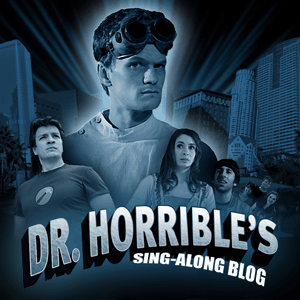
TV Journal for 2/16 - Dr. Horrible's Sing-Along Blog

Dr. Horrible's Sing-Along Blog is a show that was made by Josh Whedon (who you might know as the creator of shows like Firefly and Buffy the Vampire Slayer).  It was released as a web series in three 15min acts and was available for free.  It isn't available from their website anymore since they released it on DVD but you can find it on youtube: http://www.youtube.com/user/KarikiNeroli#p/u/5/apEZpYnN_1g.  You can also find it on Netflix for those that subscribe.

The reason Josh Whedon created this was mostly because of the writers strike that was a few years ago.  During the writers strike no new shows were happening on tv so apparently Whedon got bored and got a bunch of his friends together and made this show.  The idea was that he was trying to make something inexpensive but professional looking that would circumvent the issues that were being protested during the strike.  Most of the actors are recognizable from other shows (like Neil Patrick Harris).

The basic plot of the show is about a wanna-be evil villain named Dr. Horrible (with a PhD in Horribleness), the girl that he loves, and his arch rival Mr. Hammer.  It starts with Dr. Horrible making a video blog post about his mission to get into the secret society of the evil league of evil.  It's also a musical :)

I'm not entirely sure what the intended audience is, it definitely has some language in it that would probably make it PG-13 but of course anyone can watch it since it was on the internet, which I think was partially the point that the creator wanted to make.

One of the interesting things from an educational perspective of this show is that all throughout the show you really sympathize with the villain and not the hero.  The hero is such an egotistical jerk that you're really rooting for the villain to win because in the end he really just wants to be good at what he does.  The other educational aspect I think comes more from the situation surrounding the show than the actual show.  It was created in response to an event that was happening across the United States and it was made with that event specifically in mind.  One of the issues that the strike was dealing with is that union rights and contracts for writers had not been updated for the 20th century with new issues like DVD and internet media rights.  So I think this show is educational in the sense that Whedon was showing the world his take on the strike.  None of the cast or crew of the show got paid until after it started making money from dvd and merchandise sales.  Of course I don't think he was saying this is the solution to the strike, but it really shows what people can do when they set their mind to it.  After all, this show was not filmed with a very big budget and all the song recording was done in Josh Whedon's home.

And just as a teaser because I think everyone should watch this show...

Tuesday, February 8, 2011

Essay Draft


"How do you understand the phrase “Television and the Development of Youth?”

The first thing I think of when I hear the phrase “Television and the Development of Youth” is actually twofold.  I see the negative idea that TV is turning kids into violent criminals who can’t tell the difference between fantasy and reality but I also see the idea that TV can lead youth into a different world, a world where they can be free to see their ideas played out in a safe space where nobody gets hurt.  Kids can learn a lot from the television, and of course I think there is a value to educational programming, but I think that kids can learn from entertainment based programming as well.  I think this is especially true when it comes to lessons on social behaviors and the way our society functions as a whole.  Anything in society can be bad for us if we let it, so why not see the good in something that clearly is not going to go away anytime soon and use it to educate our children outside of the classroom and in a more informal setting?

If we can look at television through a different lens, I think we can use it as a way to trigger important conversations for youth of all ages.  In Fisherkeller’s chapter about the girl Marina, Fisherkeller talks about how when Marina watches television programs, they prompt her  to think about things other than her day to day routine.  They prompt her to think about important social issues, in this case choices regarding sexual health and the consequences that go along with it.  This might not be a conversation she would have thought to go over in her mind or discuss with someone else if she didn’t have the prompt from the program she was watching.  There is a multitude of other social situations that can prompt important discussions for youth such as drinking and drugs.  These three topics are probably the most viewed on TV, but I’m sure other social situations exist out there.  The nice thing about television programs is that different programs can explore the same situation but can explore it in a different way, or even come to a different conclusion.  This helps the viewer see how most of the time there is more than one option for anybody.

I don’t think that this kind of information can be learned solely from watching a TV sitcom, but when paired with other types of education, such as from a parent or other adult figure, it can have a powerful influence.  We should see television as a way to springboard into other conversations rather than something we need to abhor and ban from households.

Tuesday, February 1, 2011

TV Journal for 2/2 - Gigantic


The show that I watched for this week is one that I've never heard of before this week but I decided it sounded interesting so I gave it a try.  The show is called Gigantic and they air it on TeenNick.  You can find all the episodes that have aired so far here:

http://www.teennick.com/shows/gigantic/episode-guide

The show is about the lives of several high school aged kids who live in Hollywood.  The majority of the kids are either rich or famous (or both) and then a couple of the other lead characters are neither but are still friends with the others.   Anna and her younger brother Walt are the children of two famous movie stars and have just returned from two years in Australia where their parents were shooting a movie.  Their friends include Piper, the larger than life adopted daughter of an action movie star who doesn't take crap from anyone, Piper's also adopted brother Finn, Joey, the normal teen who has a mutual attraction to Anna, and Vanessa, Anna's frenemy who is a young actress.

This show is definitely geared towards younger teens.  I think what makes it so entertaining and intriguing is that the teens in the show are basically normal teens but of course they live in a very non-normal place.  They constantly have paparazzi after them or are attending swanky and expensive parties, but at heart they are just normal teens trying to deal with issues like body type, parents, and crushes.  They also get themselves into amusing situations at times.  The plot gets very juicy at times with everyone lying to everyone else and even the audience is never quite sure who is telling the truth.

As far as an educational aspect goes, I think this show definitely is educational about social issues.  There is a lot of talk about parent/child relationships and everyone in the show has a slightly different relationship with his/her parents (some good and some bad).  One of the characters, Piper, is a larger girl but is extremely confident about herself and her body.  In one episode after being insulted constantly by a blogger about her weight she tracks down the girl and finding the blogger just an overweight girl trying to compensate by putting others down, instead of having a cat fight Piper tells the girl about how girls need to stick together and not put each other down and how everyone is beautiful.  The episode ends with Piper and Anna making a sign to flash at the paparazzi.

(I couldn't get the clip to stop autoplaying so here is the link)
http://www.teennick.com/videos/clip/.html

Besides those issues, Gigantic also deals with other teen issues such as relationships, sex, and the rumor mill. It shows these in such a light as to inform and I think help kids start to think about these kinds of things or what they might do in the same situation.