For my final post about Modern Family instead of doing a post on the overall feel of the show like my other posts have been about, I decided I would take an in depth look at a specific episode. This episode is the most recent to air at the time of writing this. It aired on April 13th, 2011 and is titled "The Musical Man".
The thing that struck me most about this episode is the way the show treats the idea of the average person and the average family. Of course the show would be boring if the only things that happened were your run of the mill every day activities, but at least in this episode I realized just what average things the characters talk about and do on the show.
Some of the basic events of this episode *SPOILER ALERT* include Cameron taking over Luke and Manny's school play where everything goes wrong, Claire talking to Haley about the benefits of going to college, Phil putting an ad on his family's minivan to try and sell real estate but that ends up looking like he's selling his family, and a visit from Jay's brother whom he has a very joking relationship with. It sounds like a lot for one 30 minute episode I know, but that is the brilliance of Modern Family. Every episode is jam packed with every day life that is fun to watch.
Some of the things I noticed in this episode are:
Haley is worriedly looking up her SAT scores online and Phil says "don't worry, we're not expecting miracles" to which Haley replies "oh good". Then after finding out that her scores are average Claire says "They're average! We did it, our baby is average!" What we find funny is that they are so excited by the averageness of their daughter when what most people strive to be is anything but average. And this is just one of the parts in the episode where the show almost tries to overly heighten the averageness of the characters, which in turn makes them more of a characterization of real life. The same thing with Cam and Mitchell. Mitchell always wants Cam to be more normal and more average. He even says to Cam in this episode "Sometimes you can be a little overenthusiastic."
Modern Family takes a lot of every day situations like driving around in a minivan, or being in charge of an elementary school play or even just reminiscing about the good old days and heightens it so that we then see it as funny. A lot of people have to go see their kid in a not very good show so people can relate to that. But not everyone's kid gets stuck in the air for the entire performance because of a technical malfunction. We might not see that every day....but maybe we want to. I think humans like things that break up the monotony of their every day life. In Modern Family the characters have that every day life but at the same time one or two little things happen, escalating the humor of the situation. And that is why I think so many people enjoy this show.
Tuesday, April 19, 2011

Tuesday, April 5, 2011
Modern Family - 3
For this post I want to focus on the educational value of Modern Family. I think it is interesting because this is definitely one of those shows that I don't think was written to have educational value but was written as a entertaining sitcom that would make money for the network. On the other hand, I think there is educational moments that can be pulled out if put into the proper context.
Usually in each episode the characters that are the main point of that particular episode all want something similar and then the episode progresses by showing how each character goes about getting the thing they desire. For example: In one episode both Mitchell and Claire don't want to tell their significant other something embarrassing that they do. Mitchell doesn't want to tell Cameron that he hates it when Cam wears really tight bike shorts and Claire doesn't want to tell Phil that she hates it when he tries to tell jokes and be funny. The two siblings decide to tell the other person's significant other so that they don't have to do it themselves. So in that episode both couples learn the importance of being honest and forthcoming in a relationship.
I think the most important overarching theme of the show is the idea of the importance of family. All of the characters squabble and have their differences, but in the end each of them overcome because they have their family to back them up. It also shows the idea that every family and every couple are different, but at the same time, everyone goes through a lot of the same difficulties. In the end, we're all human and we all make mistakes.
One of the things that Modern Family also does well is show a homosexual couple in the context of being in a happy, loving, committed relationship that functions more or less like any other couple would in the situations they are faced. Cameron and Mitchell are loving parents and often function more rationally than the other couples on the show. I think this could be used in an educational context to show that no matter a person's sexual preferences, people are still people and go through the same sorts of relationship and family matters that anyone does.
Usually in each episode the characters that are the main point of that particular episode all want something similar and then the episode progresses by showing how each character goes about getting the thing they desire. For example: In one episode both Mitchell and Claire don't want to tell their significant other something embarrassing that they do. Mitchell doesn't want to tell Cameron that he hates it when Cam wears really tight bike shorts and Claire doesn't want to tell Phil that she hates it when he tries to tell jokes and be funny. The two siblings decide to tell the other person's significant other so that they don't have to do it themselves. So in that episode both couples learn the importance of being honest and forthcoming in a relationship.
I think the most important overarching theme of the show is the idea of the importance of family. All of the characters squabble and have their differences, but in the end each of them overcome because they have their family to back them up. It also shows the idea that every family and every couple are different, but at the same time, everyone goes through a lot of the same difficulties. In the end, we're all human and we all make mistakes.
One of the things that Modern Family also does well is show a homosexual couple in the context of being in a happy, loving, committed relationship that functions more or less like any other couple would in the situations they are faced. Cameron and Mitchell are loving parents and often function more rationally than the other couples on the show. I think this could be used in an educational context to show that no matter a person's sexual preferences, people are still people and go through the same sorts of relationship and family matters that anyone does.
Tuesday, March 29, 2011
Modern Family - 2
One of the things I think is really interesting about Modern Family is how the kids on the show are portrayed. Modern Family is a sitcom that has I think majorly an adult audience, yet the kids on the show play a pretty large part. Each kid has their own different personality, yet in the end even they all view themselves as a large family. It is especially amusing when the kid's end up knowing more than the parents. Take the character of Luke, for example. He is the youngest of the Dunphey clan and generally considered to be not very bright. In one of the first episodes he gets his head stuck in a banister and he is constantly not understanding what is going on in various situations. Yet, when his father really wanted an iPad for his birthday and Claire failed, Luke was the one who was able to obtain the coveted object for his father. Luke can be the savior of the family, even when nobody really believes he can do anything. Ironically, the actor who plays Luke is actually very intelligent and is a member of Mensa.
Of the other kids, the oldest Haley, is your typical popular teenager. She is pretty, popular, obsessed with boys and herself, pays little attention to her schoolwork, and is constantly rebelling against what her parents say. The middle child, Alex, is almost the exact opposite. She is studious, usually does what her parents tell her to do, and a bit of a tomboy. The two sisters clash in ways that you'd think two sisters so opposite would clash, yet the show also lets there be different sides to the characters. In one episode Haley is worried her parents are going to break up (when in reality Claire is trying to convince Haley to break up with her current boyfriend) and Haley actually shows she cares about others. There are episodes where Alex goes to Haley for advice about boys and shows that she is growing as a character as well. The sisters fight, but you can really see the love between them as well.
The other child, Sophia's son Manny, is interesting because he is as unlike a stereotypical boy his age as you can get. He's what you might call an old soul. He likes to wear ascots, sip tea, and constantly speaks with a vocabulary beyond his years. This becomes a source of conflict between him and his stepfather Jay (the patriarch of the family) as Jay is more of a traditionally masculine character. Manny is never one sided, however, and is constantly helping Jay out of jams and in one episode even has a crush on Haley. He goes through real emotional turmoil when his biological dad comes to visit and promises him things that never come to fruition. Jay is a real father to Manny even though they are so different.
And that's what I like about this show. In a lot of shows that have kids you find that the kids are very one dimensional. They are there for the cuteness factor, or so that the parents have something they have to deal with like going into see the principal. It is a little rarer to find a show that has kids with actual personalities going through their own drama, tying neatly into the drama their parents and other family members are going through. (The Cosby Show comes to mind when I try to think of a similar show). The kids really are a part of the family and the show, both on and off the set, which I think is important to the show. We feel the love of these families because they are so close off the set as well. For example, here is an interview from Entertainment Weekly with the kids and the adults. You can really see how close they are to each other and how they feed of each others' energies.
Of the other kids, the oldest Haley, is your typical popular teenager. She is pretty, popular, obsessed with boys and herself, pays little attention to her schoolwork, and is constantly rebelling against what her parents say. The middle child, Alex, is almost the exact opposite. She is studious, usually does what her parents tell her to do, and a bit of a tomboy. The two sisters clash in ways that you'd think two sisters so opposite would clash, yet the show also lets there be different sides to the characters. In one episode Haley is worried her parents are going to break up (when in reality Claire is trying to convince Haley to break up with her current boyfriend) and Haley actually shows she cares about others. There are episodes where Alex goes to Haley for advice about boys and shows that she is growing as a character as well. The sisters fight, but you can really see the love between them as well.
The other child, Sophia's son Manny, is interesting because he is as unlike a stereotypical boy his age as you can get. He's what you might call an old soul. He likes to wear ascots, sip tea, and constantly speaks with a vocabulary beyond his years. This becomes a source of conflict between him and his stepfather Jay (the patriarch of the family) as Jay is more of a traditionally masculine character. Manny is never one sided, however, and is constantly helping Jay out of jams and in one episode even has a crush on Haley. He goes through real emotional turmoil when his biological dad comes to visit and promises him things that never come to fruition. Jay is a real father to Manny even though they are so different.
And that's what I like about this show. In a lot of shows that have kids you find that the kids are very one dimensional. They are there for the cuteness factor, or so that the parents have something they have to deal with like going into see the principal. It is a little rarer to find a show that has kids with actual personalities going through their own drama, tying neatly into the drama their parents and other family members are going through. (The Cosby Show comes to mind when I try to think of a similar show). The kids really are a part of the family and the show, both on and off the set, which I think is important to the show. We feel the love of these families because they are so close off the set as well. For example, here is an interview from Entertainment Weekly with the kids and the adults. You can really see how close they are to each other and how they feed of each others' energies.
Wednesday, March 2, 2011
TV Journal for 3/2 - Modern Family
The tv show that I think I will explore for the rest of the semester is Modern Family. This is a show that is in its 2nd season and I think it is an interesting show because there are so many elements to it and so many characters to explore. The show centers around three families who are all related. Each family has their own way of living their lives and raising their kids so you get a really nice mixture of human characteristics. Modern Family plays Wednesday nights on ABC and the latest episodes can also be found on Hulu online.
The three families in the show are:
-Jay, his second, much younger, wife Gloria and Gloria's son Manny from a previous relationship
-Jay's son Mitchell, his partner Cam and their adopted daughter Lily
-Jay's daughter Claire, her husband Phil, and their three children Haley, Alex, and Luke

The great thing about this show is that they represent so many different generations, yet all of the generations are very intricately connected. During each episode there is usually some common problem that each of the three families/couples are facing and of course each family handles their problem in a different way.
I think this show has definite educational possibilities in the sense that it shows the differences between people and it really shows that even though each character lives in a family that may not be considered "normal", they are all happy and loving towards one another.
The context of watching this show is definitely for entertainment. I don't think people would watch this show because of any educational value they think it might have, though hopefully people would be able to pull educational moments out of the show. I usually watch this show online off of Hulu because I have class when it airs, though I think it is one of those shows that people do watch live when it airs. I usually end up watching this show by myself, but it is one that I think would also be fun to watch in a group setting as well. This is a show that is billed for adults, yet because of the kids in the show and the situations they get into, younger audiences can find an interest in it as well.
The three families in the show are:
-Jay, his second, much younger, wife Gloria and Gloria's son Manny from a previous relationship
-Jay's son Mitchell, his partner Cam and their adopted daughter Lily
-Jay's daughter Claire, her husband Phil, and their three children Haley, Alex, and Luke
The great thing about this show is that they represent so many different generations, yet all of the generations are very intricately connected. During each episode there is usually some common problem that each of the three families/couples are facing and of course each family handles their problem in a different way.
I think this show has definite educational possibilities in the sense that it shows the differences between people and it really shows that even though each character lives in a family that may not be considered "normal", they are all happy and loving towards one another.
The context of watching this show is definitely for entertainment. I don't think people would watch this show because of any educational value they think it might have, though hopefully people would be able to pull educational moments out of the show. I usually watch this show online off of Hulu because I have class when it airs, though I think it is one of those shows that people do watch live when it airs. I usually end up watching this show by myself, but it is one that I think would also be fun to watch in a group setting as well. This is a show that is billed for adults, yet because of the kids in the show and the situations they get into, younger audiences can find an interest in it as well.
Tuesday, February 15, 2011
TV Journal for 2/16 - Dr. Horrible's Sing-Along Blog

The reason Josh Whedon created this was mostly because of the writers strike that was a few years ago. During the writers strike no new shows were happening on tv so apparently Whedon got bored and got a bunch of his friends together and made this show. The idea was that he was trying to make something inexpensive but professional looking that would circumvent the issues that were being protested during the strike. Most of the actors are recognizable from other shows (like Neil Patrick Harris).
The basic plot of the show is about a wanna-be evil villain named Dr. Horrible (with a PhD in Horribleness), the girl that he loves, and his arch rival Mr. Hammer. It starts with Dr. Horrible making a video blog post about his mission to get into the secret society of the evil league of evil. It's also a musical :)
I'm not entirely sure what the intended audience is, it definitely has some language in it that would probably make it PG-13 but of course anyone can watch it since it was on the internet, which I think was partially the point that the creator wanted to make.
One of the interesting things from an educational perspective of this show is that all throughout the show you really sympathize with the villain and not the hero. The hero is such an egotistical jerk that you're really rooting for the villain to win because in the end he really just wants to be good at what he does. The other educational aspect I think comes more from the situation surrounding the show than the actual show. It was created in response to an event that was happening across the United States and it was made with that event specifically in mind. One of the issues that the strike was dealing with is that union rights and contracts for writers had not been updated for the 20th century with new issues like DVD and internet media rights. So I think this show is educational in the sense that Whedon was showing the world his take on the strike. None of the cast or crew of the show got paid until after it started making money from dvd and merchandise sales. Of course I don't think he was saying this is the solution to the strike, but it really shows what people can do when they set their mind to it. After all, this show was not filmed with a very big budget and all the song recording was done in Josh Whedon's home.
And just as a teaser because I think everyone should watch this show...
Tuesday, February 8, 2011
Essay Draft
"How do you understand the phrase “Television and the Development of Youth?”
The first thing I think of when I hear the phrase “Television and the Development of Youth” is actually twofold. I see the negative idea that TV is turning kids into violent criminals who can’t tell the difference between fantasy and reality but I also see the idea that TV can lead youth into a different world, a world where they can be free to see their ideas played out in a safe space where nobody gets hurt. Kids can learn a lot from the television, and of course I think there is a value to educational programming, but I think that kids can learn from entertainment based programming as well. I think this is especially true when it comes to lessons on social behaviors and the way our society functions as a whole. Anything in society can be bad for us if we let it, so why not see the good in something that clearly is not going to go away anytime soon and use it to educate our children outside of the classroom and in a more informal setting?
If we can look at television through a different lens, I think we can use it as a way to trigger important conversations for youth of all ages. In Fisherkeller’s chapter about the girl Marina, Fisherkeller talks about how when Marina watches television programs, they prompt her to think about things other than her day to day routine. They prompt her to think about important social issues, in this case choices regarding sexual health and the consequences that go along with it. This might not be a conversation she would have thought to go over in her mind or discuss with someone else if she didn’t have the prompt from the program she was watching. There is a multitude of other social situations that can prompt important discussions for youth such as drinking and drugs. These three topics are probably the most viewed on TV, but I’m sure other social situations exist out there. The nice thing about television programs is that different programs can explore the same situation but can explore it in a different way, or even come to a different conclusion. This helps the viewer see how most of the time there is more than one option for anybody.
I don’t think that this kind of information can be learned solely from watching a TV sitcom, but when paired with other types of education, such as from a parent or other adult figure, it can have a powerful influence. We should see television as a way to springboard into other conversations rather than something we need to abhor and ban from households.
Tuesday, February 1, 2011
TV Journal for 2/2 - Gigantic

The show that I watched for this week is one that I've never heard of before this week but I decided it sounded interesting so I gave it a try. The show is called Gigantic and they air it on TeenNick. You can find all the episodes that have aired so far here:
http://www.teennick.com/shows/gigantic/episode-guide
The show is about the lives of several high school aged kids who live in Hollywood. The majority of the kids are either rich or famous (or both) and then a couple of the other lead characters are neither but are still friends with the others. Anna and her younger brother Walt are the children of two famous movie stars and have just returned from two years in Australia where their parents were shooting a movie. Their friends include Piper, the larger than life adopted daughter of an action movie star who doesn't take crap from anyone, Piper's also adopted brother Finn, Joey, the normal teen who has a mutual attraction to Anna, and Vanessa, Anna's frenemy who is a young actress.
This show is definitely geared towards younger teens. I think what makes it so entertaining and intriguing is that the teens in the show are basically normal teens but of course they live in a very non-normal place. They constantly have paparazzi after them or are attending swanky and expensive parties, but at heart they are just normal teens trying to deal with issues like body type, parents, and crushes. They also get themselves into amusing situations at times. The plot gets very juicy at times with everyone lying to everyone else and even the audience is never quite sure who is telling the truth.
As far as an educational aspect goes, I think this show definitely is educational about social issues. There is a lot of talk about parent/child relationships and everyone in the show has a slightly different relationship with his/her parents (some good and some bad). One of the characters, Piper, is a larger girl but is extremely confident about herself and her body. In one episode after being insulted constantly by a blogger about her weight she tracks down the girl and finding the blogger just an overweight girl trying to compensate by putting others down, instead of having a cat fight Piper tells the girl about how girls need to stick together and not put each other down and how everyone is beautiful. The episode ends with Piper and Anna making a sign to flash at the paparazzi.
(I couldn't get the clip to stop autoplaying so here is the link)
http://www.teennick.com/videos/clip/.html
Besides those issues, Gigantic also deals with other teen issues such as relationships, sex, and the rumor mill. It shows these in such a light as to inform and I think help kids start to think about these kinds of things or what they might do in the same situation.
Sunday, January 23, 2011
TV Journal for 1/26 - Gilmore Girls
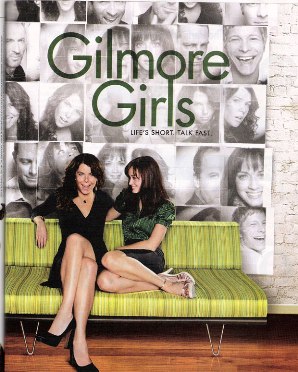
Gilmore Girls ran from 2000 to 2007 (7 Seasons) on the WB and now can be found either on DVD or on Sidereel: http://www.sidereel.com/Gilmore_Girls
The show centers on the characters of single mother Lorelai Gilmore and her daughter Rory Gilmore and takes Rory from her first year of high school to past college. Lorelai had Rory when she was 16 and the two have an extremely close relationship, usually acting more like friends than parent/child and usually going back and forth between who is the more responsible one as a lot of the time Rory is in fact the one taking care of Lorelai. One of the distinguishing features of the show as a whole is that all of the characters talk extremely fast and spout a large number of references to other things (mostly pop culture). According to IMDB, the script for one episode of Gilmore Girls is roughly twice as many pages as a normal hour long show because of the amount of dialogue.
As written in wikipedia, "The series explores issues of family, friendship and romance, as well as generational divides and social class. Ambition, education and work also form part of the series' central concerns, telling Lorelai's story from pregnant teen runaway and high school dropout to co-owner and manager of the Dragonfly Inn. Rory's transition from public school to the prestigious preparatory school, Chilton, is similarly followed by the series, exploring her ambition to study at an Ivy League college and to become a foreign correspondent. The show's social commentary manifests most clearly in Lorelai's difficult relationship with her wealthy upper-class parents, Emily and Richard Gilmore, and in the interactions between the students at Chilton, and later, Yale University."
I'm not entirely sure what demographic the producers of the show were intending for their audience, but I believe viewers young and old enjoy the show. According to wikipedia throughout the first 4 seasons of the show it came in first with women 18-25 and it also has won numerous family show awards.
I think the show has a lot of appeal to different ages because of the types of issues that Gilmore Girls explores as stated above. It is clearly a show for entertainment but I think there are still things to be learned and educational possibilities that come from the show. One of which, is definitely the importance of family and being there for the people you care about. You even find that idea in the opening credits with the theme song: http://www.youtube.com/watch?v=bhIRywAOjZ0
The two main characters have a unique relationship, which I think a lot of people probably wish they could have with their parents. And while the two lead women have their fights, in the end they really do need and love each other. There is also definitely a running commentary about social class and socioeconomic status throughout the show. Lorelai's parents are in the wealthy elite and when she becomes pregnant, Lorelai (at least in her parents eyes) brings shame to her family and to their reputation. Instead of sitting back and accepting what her parents deem to be appropriate (namely marrying Rory's father and staying quietly at home) she longs for adventure and so takes off on her own effectively estranging herself from them until the time that she realizes she can't afford to send Rory to her dream school and so asks them for help. Throughout the series there are a lot of conflicts that arise in the form of money and status which is an interesting topic that not tons of shows often explore.
Gilmore Girls uses a mixture of drama and comedy to explore deeper issues, but at the heart it is never an "educational show" which, I think, is one of the reasons it is so popular, even now after it has been off of the air for 3+ years.
Subscribe to:
Posts (Atom)